
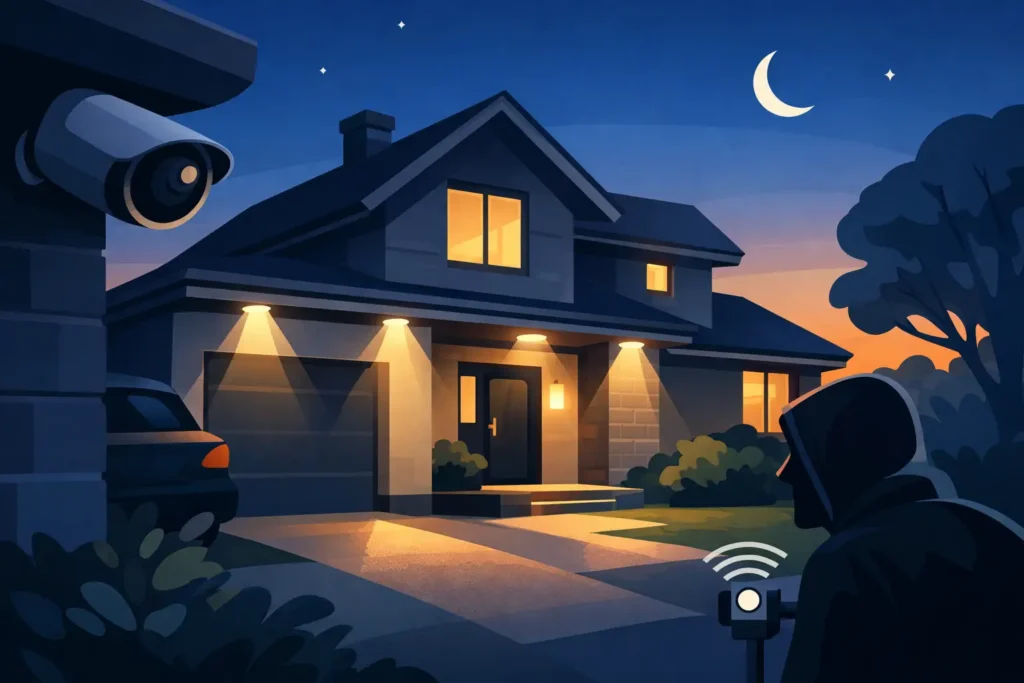
A dark side yard, a shadowed entry, or a backyard that disappears after sunset can make a home feel less welcoming than it should. That is where security downlighting for homes stands out. It gives you practical visibility where it matters most while keeping the look clean, polished, and far more attractive than harsh floodlights.
For Arizona homeowners, that balance matters. You want lighting that helps your family move around safely, discourages unwanted activity, and still makes the house look sharp at night. Good downlighting does all three when it is planned well.
What security downlighting for homes really does
Security lighting often gets treated like a purely functional upgrade, but the best systems do more than blast light across the yard. Security downlighting for homes is designed to cast light downward from the roofline, eaves, or other architectural points so key areas are illuminated without creating the glare that comes with many traditional fixtures.
That downward wash of light helps define walkways, entrances, garages, patios, and side yards. It also reduces the deep pockets of darkness around a property where visibility drops off fast. When your home has even, intentional exterior lighting, it becomes easier to see who is approaching, easier to use outdoor spaces at night, and easier to create a home that feels cared for.
There is also a visual benefit homeowners sometimes underestimate. Downlighting tends to look more refined than exposed spotlights or bulky motion lights. Instead of making your home feel overlit, it adds shape and depth. You get security, but you also get a better nighttime appearance.
Why homeowners are moving beyond basic floodlights
Old-school security lights usually solve one problem by creating another. Yes, a bright floodlight can light up a driveway or side gate, but it can also produce glare, hot spots, and that jarring look that makes a home feel more commercial than residential.
That is why more homeowners are choosing permanent, professionally installed lighting systems that can handle both security and style. A better setup spreads light more evenly and places it where people actually need it. Instead of one blinding fixture over the garage, you get a thoughtful lighting layout that supports the whole property.
This is especially useful for families who use their outdoor spaces year-round. In places like Phoenix and across Arizona, evenings are part of daily life. People grill outside, let kids play in the yard, host friends on the patio, and come home after dark from sports, school events, or work. Security lighting should support that lifestyle, not just switch on like a warning beacon.
Where downlighting makes the biggest difference
The strongest security lighting plans usually focus on transition zones. These are the areas where people enter, exit, walk, or gather, and they are also the places where visibility matters most.
Front entries are an obvious starting point. A well-lit porch and approach help guests feel comfortable and help homeowners identify movement near the door. Garages and driveways are another priority because they are often used multiple times a day and can become awkward or unsafe when visibility drops.
Side yards are one of the most overlooked areas. They are narrow, often underlit, and commonly used for gates, trash bins, AC access, and storage. Adding downlighting here can make a home feel dramatically more secure.
Back patios and pool areas matter too. Even if the goal starts with security, these are spaces where function and atmosphere naturally overlap. You want enough light to move safely and keep sightlines open, but not so much that the backyard loses its relaxed feel.
The advantage of permanent lighting over temporary fixes
A lot of homeowners piece together exterior lighting over time. One motion light here, a solar path light there, maybe a porch fixture upgrade when the old one fails. The problem is that this approach rarely creates a consistent result. It can leave dark gaps, mismatched color temperatures, and fixtures that do not hold up in extreme weather.
Permanent lighting changes that. With a professionally installed system, the lighting is designed as a complete solution instead of a collection of separate fixes. The look is cleaner, the performance is more reliable, and the day-to-day experience is much easier.
That convenience matters more than people think. When lighting is built into the home and controlled through an app, you do not have to keep adjusting timers, replacing bulbs, or dragging out seasonal products. The same system that supports security can also shift for holidays, celebrations, game days, or simple evening ambiance.
That flexibility is part of what makes this type of lighting so appealing. It is not single-purpose. It works hard every night and still gives you room to have fun with your home.
What to look for in a security downlighting system
The best system is not always the brightest one. In fact, too much brightness can work against you by creating glare and deep contrast. What you want is controlled, layered light that makes the property easier to see and easier to enjoy.
Fixture placement is the first big factor. Lights should be positioned to cover entries, paths, gathering spaces, and edges of the home without shining directly into windows or neighboring properties. Beam spread matters just as much as brightness because coverage is what creates confidence.
Durability is another major piece of the decision. In Arizona, exterior systems need to handle heat, sun exposure, dust, and seasonal weather swings. A weatherproof, professionally installed setup is going to perform better and look better over time than bargain fixtures that fade, shift, or fail early.
Control is where modern systems really separate themselves. App-based lighting lets you schedule on and off times, change colors when appropriate, and fine-tune the mood of the home without touching the hardware. That makes security lighting feel less like a chore and more like a smart home feature you will actually use.
Security and curb appeal do not have to compete
Some homeowners hesitate because they assume security lighting will make the house look harsh or overdone. That can happen with the wrong setup, but quality downlighting usually has the opposite effect.
When light falls cleanly across architectural lines, roof edges, and entry points, the home looks more finished after dark. It feels lived in, maintained, and inviting. Those visual cues matter. A well-lit home tends to project attention and presence, which is exactly what you want from a security standpoint.
There is a practical trade-off, though. If your only priority is maximum brightness at all costs, you might choose a more aggressive lighting style. But most homeowners want a balance. They want enough visibility to improve safety and awareness without washing out the whole exterior. Downlighting is often the sweet spot because it supports both goals.
Professional design makes a visible difference
This is one of those upgrades where installation quality shows right away. Poorly placed fixtures create uneven light, exposed hardware, and awkward shadows. A professional design takes the shape of the home, the use of the space, and the goals of the homeowner into account.
That is especially valuable if you want one system to do more than one job. A house may need reliable nightly illumination for security, softer lighting for entertaining, and customizable color options for holidays or events. When the system is designed correctly from the start, those functions can work together instead of competing.
That is where a company like Trimlight Phoenix fits naturally for homeowners who want a permanent solution instead of another temporary patch. A professionally installed, programmable system gives you security lighting that looks intentional every day of the year, not just when you remember to turn something on.
Is security downlighting right for every home?
Usually, yes, but the layout should match the property. A compact single-story home may need a different plan than a large two-story house with multiple access points. A home with a pool, detached garage, or RV gate will have different lighting priorities than one focused mostly on front-yard curb appeal.
It also depends on how you use the home at night. If your family is constantly outside after sunset, you may want broader coverage and more programmable scenes. If your main concern is entry visibility and side-yard security, the layout can be simpler. The point is not to copy a neighbor’s lighting. It is to build a system that actually matches your routines.
The best exterior lighting does not scream for attention. It quietly makes your home easier to enjoy, easier to move through, and easier to feel good about after dark. If you are tired of patchwork fixtures and tired of choosing between safety and style, security downlighting for homes is one upgrade that earns its place every single night.